
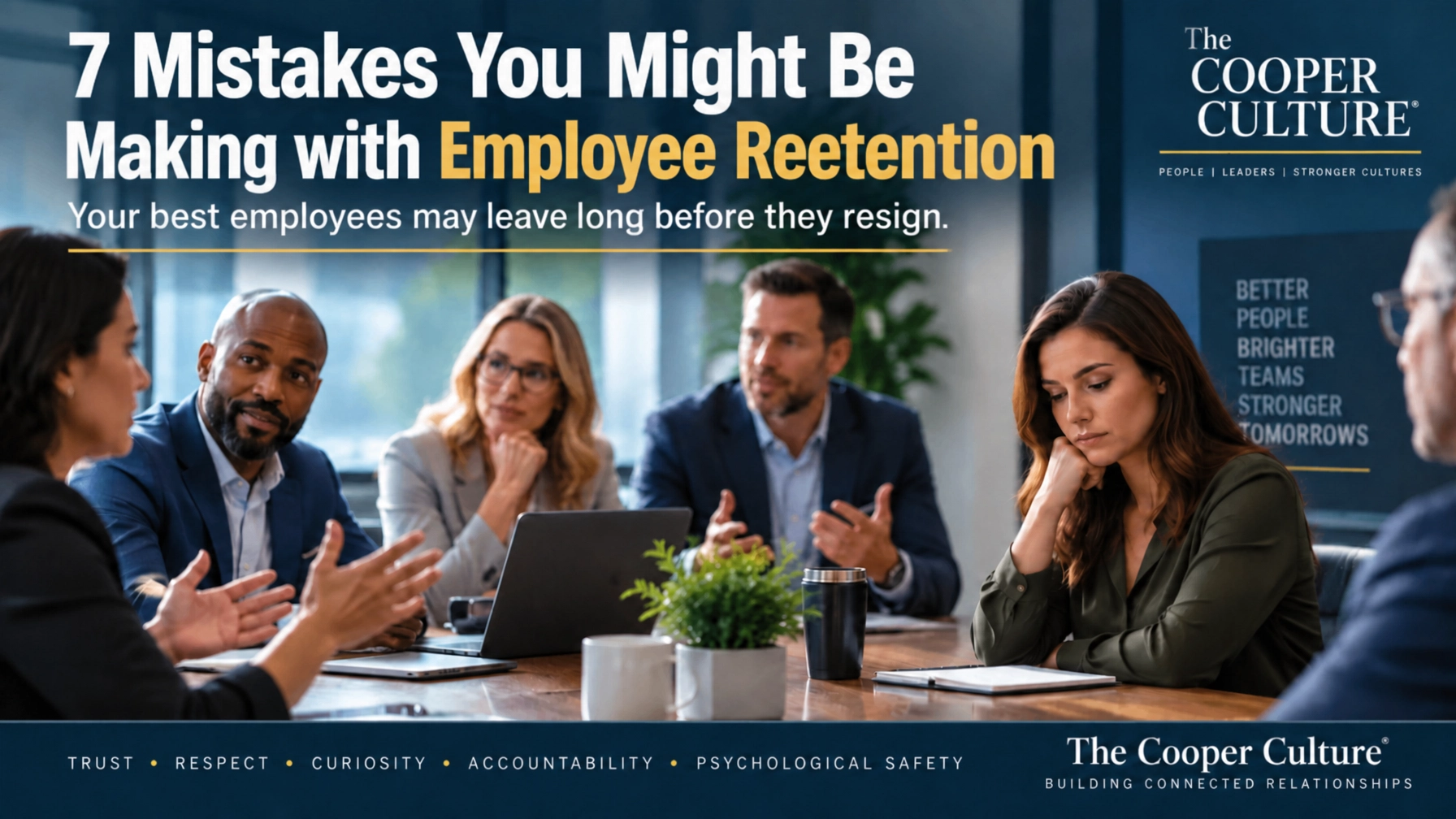
You hired good people.
You invested time and money in training them. You gave them responsibilities, introduced them to your customers, and trusted them to help accomplish your mission.
Then they left.
The immediate question is usually, “Why?”
Was it money? A better opportunity? Benefits? More flexibility? A shorter commute?
Perhaps.
But after decades of leading people—from the cockpit and military organizations to cooperate in America and business—we have learned something important:
People frequently make the decision to leave long before they resign.
The resignation letter may be the final step. The real departure may have started months earlier.
It started when trust was damaged. When an employee stopped feeling heard. When a good idea was dismissed. When expectations became unclear. When someone felt disrespected. Or when an employee decided it was safer to remain silent than to speak honestly.
If you are having difficulty retaining good people, take a hard look at these seven mistakes.
1. You Think Retention Is Primarily About Money
Compensation matters. People deserve to be compensated fairly for the value they provide.
But money cannot compensate indefinitely for a culture people don’t want to be part of.
A salary increase doesn’t repair a broken relationship with a supervisor. A bonus doesn’t create trust. Better benefits don’t make someone feel respected.
You can pay someone enough to stay physically while losing them mentally and emotionally.
That’s when you begin seeing employees who are present—but no longer fully engaged.
Retention is not simply about keeping someone on the payroll. It is about creating an environment where good people still want to contribute.
2. You Wait Until the Exit Interview to Ask What’s Wrong
If the first time you seriously ask an employee about their concerns is when they’re walking out the door, you’re too late.
Leaders need to be curious before there is a crisis.
Ask:
What is getting in the way of your success?
What could we be doing better?
Is there something you think I need to know?
And perhaps most importantly:
What aren’t we talking about?
But asking isn’t enough.
Employees must believe they can answer honestly without being punished, embarrassed, ignored, or labeled a troublemaker.
Curiosity without psychological safety will not produce honest answers.
3. You Confuse Silence with Agreement
This may be one of the most dangerous mistakes a leader can make.
Nobody objected in the meeting.
Nobody challenged the decision.
Nobody questioned the new policy.
So everyone must agree—right?
Not necessarily.
Silence can mean agreement. But it can also mean fear, frustration, resignation, lack of confidence, or simply, “I’ve learned that speaking up around here isn’t worth it.”
We want leaders to become curious about silence.
When the same two or three people dominate every discussion, what are the others thinking?
When an experienced employee suddenly stops offering suggestions, why?
When someone who used to be enthusiastic becomes quiet, what changed?
Don’t automatically interpret silence as satisfaction. Sometimes silence is an early warning.
4. You Tolerate Disrespect Because Someone Is a High Performer
One person can produce outstanding numbers and still damage your organization.
Leaders sometimes tolerate behavior from a high performer that they would never accept from anyone else.
Sarcasm. Belittling comments. Gossip. Public criticism. Social media attacks. Dismissing other people’s ideas. Taking credit for someone else’s work.
The justification is often:
“Yes, I know they’re difficult but look at the results they produce.”
Look more closely at the results.
How many people have stopped contributing because of that person’s behavior?
How much trust has been lost?
How many good employees are quietly looking for another job?
Performance without respect comes with a cost.
Your best people are watching what leaders tolerate.
5. You Don’t Make It Safe to Ask Questions
We believe curiosity is essential to a healthy culture.
Yet many employees hesitate to ask questions because they’re afraid of how others will perceive them.
“I should already know this.”
“They’ll think that’s a stupid question.”
“I don’t want to look inexperienced.”
“My supervisor doesn’t like being questioned.”
Think about the consequences.
Questions aren’t asked. Assumptions aren’t challenged. Mistakes aren’t caught. Opportunities aren’t explored.
And eventually people learn to keep their thoughts to themselves.
A psychologically safe workplace isn’t one where everyone agrees. It is one where people can respectfully ask questions, challenge assumptions, admit uncertainty, and contribute ideas without fear of humiliation.
The question someone is afraid to ask may be exactly the question your organization needs.
6. You Allow Resentment to Grow Unaddressed
Resentment rarely announces itself.
It grows quietly.
An employee feels overlooked for a promotion.
Someone believes expectations are applied unfairly.
A manager makes a promise and doesn’t follow through.
An employee’s contribution goes unrecognized.
One incident may seem insignificant. But unresolved issues accumulate.
We’ve identified a progression we call the Three R’s: Resentment, Resistance, and Revenge.
Resentment is often internal.
Resistance begins affecting behavior.
Revenge may show up as deliberate disengagement, withholding information, undermining leadership, damaging relationships—or leaving the organization entirely.
Leaders often focus on the final behavior without recognizing what happened before it.
Don’t wait for resentment to become resistance before you start listening.
7. You Think Retention Is HR Responsibility
Human Resources has an important role in employee retention.
But culture isn’t created in the HR department.
It is created in everyday interactions.
It’s created when a supervisor responds to a mistake.
It’s created when an employee disagrees with the boss.
It’s created when credit is given—or taken.
It’s created when someone needs help.
It’s created when a leader makes a promise.
And it’s created by what leaders permit when someone violates the organization’s stated values.
Every leader who influences another person influences your culture.
Retention is a leadership responsibility.
Before Another Good Employee Walks Out the Door
Maybe the better question isn’t:
“Why are people leaving?”
Maybe it’s:
“What are they experiencing while they’re here?”
Do they feel respected?
Do they trust their leaders?
Can they ask questions?
Can they disagree respectfully?
Are their contributions valued?
Do they believe the organization’s stated values are actually lived?
And would they recommend your organization to someone they care about?
Those questions can be uncomfortable.
They can also be invaluable.
At The Cooper Culture, we believe strong organizations are built through connected relationships grounded in trust, respect, curiosity, accountability, and psychological safety.
Employee retention isn’t solved by one program, one survey, or one motivational speech.
It begins with culture.
And culture begins with how we treat one another.
One Question for Your Leadership Team
At your next leadership meeting, don’t begin by asking, “How do we improve retention?”
Ask this instead:
“What might our best employees be experiencing right now that they haven’t felt safe enough to tell us?”
Then be quiet.
And listen.
The Cooper Culture
Building connected relationships. Strengthening leaders. Creating cultures where people want to stay.
If employee retention, trust, communication, or psychological safety is becoming a concern in your organization, Ron and Marty Cooper work with leaders and teams through speaking, leadership development, and behavioral training to help uncover what may be happening beneath the surface.
